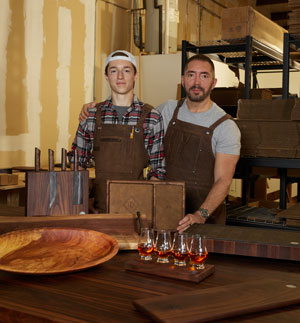
An emergency room physician and his son weathered the stress of the pandemic through their shared love of woodworking.
There are few good things to say about the coronavirus pandemic. For a local father and son, however, covid offered an unexpected opportunity to embrace their creative side.

For most of his adult life – and especially during the pandemic – Martinez resident Lou Ciamillo, an emergency medicine physician and associate professor of emergency medicine for more than 20 years, has found solace in woodworking.
The craft became a refuge for his 21-year-old son, also named Lou, during the pandemic as well. Restless from having to take college classes online, he decided to try his hand at woodworking in 2020.
“I started doing it at the height of covid. I was really bored, so I tried it,” he says. “I was bad at it at first, but my dad taught me.”
After all, it was hard for the elder Ciamillo to miss his son’s growing interest in working with wood.
“Every day when I came home from the hospital, he was making something in the garage,” he says.
Following the Process
The elder Ciamillo got his start in woodworking when he and his wife, Pam, built their first home about 20 years ago. His father-in-law, who worked in construction, was the builder, and he wanted to help.
“I bought a few tools, and then I kept buying things. Two years later, I had every tool known to man in my garage,” he says. “I got the bug for woodworking and never stopped. Most people have pictures of their families on their phone. I have pictures of wood.”
The physician has found that he sometimes uses similar skills sets when practicing medicine and working with wood.
“Medicine requires what I call de-construction,” he says. “It gets to a point where you have to figure out what’s going on and deal with each thing one at the time and realize the additive effects of what you’re doing. In medicine, you have to understand the effects of interventions on other organ systems. That’s what I like about the ER. You’re basically starting from nothing and building up to something.
“Woodworking is the same. There’s a process. You have to de-construct everything to make a product,” he continues. “You start with raw materials, and you have to troubleshoot.”
Star of the Show
The Ciamillos make functional pieces, using almost exclusively walnut and pecan, and occasionally sycamore, wood that is milled in South Carolina. Natural finishes on the products let the wood be “the star of the show.”
“Every piece has to have its own universe, its own place,” the elder Ciamillo says. “We like pieces with a live edge. It gives them a nature element.”
The woodworkers use dry, not green, wood with no twists or cupping. They also look at the figure of the grain.
“We lean into the imperfections because I think it makes for a more interesting piece,” says the elder Ciamillo.
They now make charcuterie boards, grill boards with handles, double-sided magnetic knife blocks, valet trays, valet trays with a Qi charging tray, whiskey and wine flights, bowls and cutting boards.
The Ciamillos also designed a wine flight for Cork and Flame and made a walnut tableside cutting board, as well as a whiskey flight, for the Evans restaurant.
It was the younger Ciamillo who first suggested that they try to sell their goods, and in February 2021, they started a Facebook page to showcase and sell their work to finance their hobby.
Their pieces also are available at ciamillowoodworks.com, and they will have a booth at the Aiken’s Makin’ and Arts in the Heart of Augusta festivals this month.
Creative Days
The Ciamillos currently work out of a 2,100-square-foot shop in Martinez, where the younger Ciamillo spends about 16 hours a day woodworking.
“There’s no time on the clock for this,” he says. “We listen to country music and sing when we do our work. We enjoy each other’s company.”
Their favorite days are the ones they call “creative days,” when they come up with new ideas or make things they’ve never made before.
The younger Ciamillo often lets ideas roll around in his head, but he never hesitates to ask his father for help. He says his best idea has been making valet trays.
“I’m the type of guy that carries a lot of things in my pocket,” he says. “I wanted a valet tray of my own. I thought there are probably a lot of other guys like me.”
He enjoys 3D modeling and 3D design, and he taught himself how to operate their CNC (computerized numeric control) machine. This machine cuts or moves various materials, including wood. Instead of being controlled by a human operator, the machine’s movements are calculated and carried out by a computer on a pre-programmed path.
Father and son love working together, and they share a daily ritual that they never miss. Every afternoon they get a smoothie – dates, raspberries and bananas for the elder Ciamillo and muscle punch for his son.
“Working with my dad is the best choice I ever made,” the younger Ciamillo says. “We’re very similar. We’re both hard-headed and creative. Even on our worst days, I wouldn’t want to be anywhere else.”
By Betsy Gilliland


While she was collecting furnishings and décor for their home, which includes many family pieces, Barbara had the design in mind all along. The art, cathedrals and homes of Europe were her inspiration for the interior of the Tuscan-style house. A large veranda lines the back of the house, and the spacious rooms are filled with elements of nature such as wood, stone, wrought iron accessories and earth tones.
“I like a mix of furnishings. I’m not a minimalist. I’m much more traditional,” says Barbara.
Originally in an old house in south Georgia, the wood fireplace is built on top of a travertine tile base to meet code specifications.
Open Space
Furnishings include a 1917 German credenza that the Frantoms bought in Louisiana. An old working cutting table, which came from Cleveland, serves as the spot for casual dining. Barbara found it at the Atlanta Market, and, from wine bottles and glasses to grapes and cutting boards, she has arranged the tabletop with all the makings of the perfect Tuscan picnic.
She also furnished the master bath with a dresser and another armoire. The crystal chandelier in the master bath, which includes a soaking tub, walk-in shower and travertine tile floor, came from her mother’s dining room.
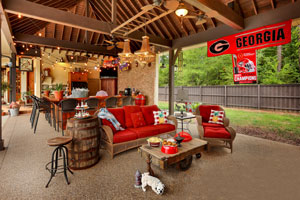
While traces of Europe are prevalent throughout the interior, the covered outdoor kitchen and sitting area are pure Americana. Especially on game day during football season.
Popular Demand
The kitchen is her happy place, and she loves to find fresh ingredients at farmers’ markets in Evans, Augusta and Thomson.


Most of the juniors are age 12 or older, and they participate in organized events through entities such as GISA and the Scholastic Clay Target Program. While 650 young shooters from 45 schools throughout Georgia participate in GISA events, 840 shooters take part in SCTP competitions.
GISA events run from the beginning of the school year through early winter, and Pinetucky will hold the first of four GISA competitions on August 20. Pinetucky continues shooting events with SCTP from January through early summer.
Skeet shooters go from station to station on a semi-circular field, and the goal is to hit two clay targets that are crossing one another. Two target machines are placed 40 meters apart – one at the high house, which is 10 feet high, and one at the low house, which is 3 1/2 feet high. Both targets rise to a maximum height of 15 feet by the time they reach the center of the field.
Two 18-year-old participants, Kinzie Louthan of Martinez and Jackson Ansley of Augusta, who graduated from Augusta Christian and Aquinas, respectively, in the spring, appreciate the emphasis on safety.